
Phase 6. Initial action steps. Six-phase method.

After completing the previous five phases, it is time to turn reflection into movement. The person has already explored their current situation, their aspirations, the limitations they need to manage, the resources available to them and the opportunities that exist in their environment. Phase 6 brings all of this together and turns it into realistic, meaningful and sustainable first actions.

The central question is simple:
What realistic and sustainable first steps can this person begin to take towards their aspirations?
BeyondWheels does not approach this phase as a rigid long-term plan or as the moment for a dramatic transformation. Its goal is progressive autonomy: beginning to move through decisions and actions that can be sustained within the person’s real circumstances. The method deliberately contrasts this with heroic transformation and places small, sustainable movement at the centre of the phase.

Integrating the journey
Before deciding what to do, it is useful to look back and bring together what has been learned:
Where am I now?What do I want?Which limitations do I need to manage?Which capabilities, resources and support do I have?Which opportunities in my environment are worth exploring?Which direction makes the most sense at this point?
Phase 6 does not start from zero. It brings together the previous five zones of the Life Map so that action does not become disconnected from everything discovered during the process.
The movement proposed by BeyondWheels can take many different forms. For one person it may mean exploring employment; for another, beginning training, developing a small independent activity, testing a freelance service, participating in a community project, exploring remote work, creating a more sustainable routine or expanding their support network. The manual explicitly includes traditional employment, part-time participation, remote work, entrepreneurship, freelance work, digital services, social economy initiatives and hybrid models. The criterion is not to fit the person into a predetermined form of employment, but to build a pathway compatible with their capabilities, aspirations, context and autonomy needs.
Identity and action
This phase is not only about building tasks. The person’s relationship with their future, autonomy, capabilities and vocational identity also begins to change.
Phase 1 explored how the person perceived themselves in relation to work.
Phase 6 returns to that question from a different position:
What kind of person am I becoming through these actions?
Which identity am I strengthening?
Which narrative about myself am I beginning to change?
What does progressive autonomy mean to me?
BeyondWheels explicitly connects identity and action: aspirations become directions, directions become goals and goals become small actions. The person does not need to solve their entire future at once; they need to begin moving.
This relationship between vocational identity and support has a point of contact with the Psychologically Informed Employment Counselling Framework (PIE-CF) developed by Peter Smith (2026) within Australian Customised Employment practice. The framework integrates counselling, vocational rehabilitation and trauma-informed practice, giving a central role to relational safety, trust and exploration of vocational identity. It is a conceptual and practice-based framework, not an experimental trial, so it is relevant as a complementary reference rather than as causal evidence for the BeyondWheels method.
Defining priorities
When several aspirations are open at the same time, the task is to narrow the field without turning the choice into a permanent decision.
BeyondWheels proposes considering:
the importance of that direction to the person;
its sustainability;
its accessibility;
the resources available;
the emotional energy it requires;
the realistic possibility of beginning to move;
its ability to generate confidence and momentum;
and its compatibility with progressive autonomy.
The priority does not have to be the most ambitious option or the one that produces the fastest results. It should be the one that allows movement without breaking the relationship between desire, realistic possibilities, resources and sustainability.
From priority to goal
Once a direction has been chosen, it is translated into an initial goal that is concrete enough to guide action.
BeyondWheels uses SMART logic through five criteria:
Specific · Measurable · Achievable · Relevant · Time-oriented
The SMART acronym comes from the article published by George T. Doran in 1981, There’s a S.M.A.R.T. Way to Write Management’s Goals and Objectives. Doran’s original formulation used Specific, Measurable, Assignable, Realistic and Time-related; later versions modified some of these terms, and BeyondWheels uses the contemporary version Specific, Measurable, Achievable, Relevant and Time-oriented.
An intention such as:
“I want to change my life.”
can therefore become:
“During the next month, I will explore three accessible online training options related to my interests.”
It could also become:
“During the next month, I will test a small digital service that I could offer independently.”
“I will create a simple portfolio to explore freelance opportunities.”
“I will contact two organisations related to social entrepreneurship.”
The aim is not to turn life into a spreadsheet. The method itself insists that goals should remain flexible and human.
Roadmap and milestones
The initial goal is then organised into a simple roadmap.
The purpose is not to predict every movement or control everything that will happen. The roadmap functions as a visual orientation that helps maintain movement and recognise signs of progress.
It may be organised around moments such as:
Exploration —looking for information, talking with others, trying small experiences—.
Preparation —training, reviewing the CV, organising support—.
Initial participation —small projects, applications, volunteering or testing an activity—.
Consolidation —maintaining routines, strengthening capabilities and expanding opportunities—.
For freelance or entrepreneurial projects, the manual also introduces the possibility of a validation stage, in which small activities or services are tested before greater resources are invested.
Milestones are concrete signs that something is moving: completing a course, submitting an application, contacting an organisation, testing a digital tool, attending a workshop, creating a portfolio or having a first conversation with a potential client.
The manual uses a 30-, 60- and 90-day sequence as an example, not as a mandatory structure:
Day 30: a first clear and achievable milestone.Day 60: a milestone building on what was learned during the first month.Day 90: a first observable result, such as an application submitted, confirmed enrolment in training or an initial professional conversation.
Timelines should be adapted to each person’s rhythm, energy and circumstances.
Anticipating risks and preparing support
Taking action also means anticipating what could make the journey more difficult.
The purpose is not to imagine everything that might go wrong. It is to prevent a foreseeable difficulty from dismantling the plan when it appears.
BeyondWheels links each risk to a concrete response:
Risk | Possible response or support |
Loss of motivation | Smaller steps, follow-up, support |
Fatigue or overload | Sustainable pace, rest |
Fear of failure | Gradual exposure |
Accessibility barriers | Adaptations, remote alternatives |
Isolation | Support networks |
Confusion | Prioritisation and structure |
Each milestone can be accompanied by one question:
What could make this step difficult, and what or who could help me sustain it?
This might be someone to call, a routine to maintain, a specific adaptation, a smaller back-up action or a follow-up structure.
Sustainability and progressive autonomy
BeyondWheels does not equate autonomy with doing everything without help.
A person may gain autonomy by learning to organise support, ask for help effectively, make decisions with greater independence, build sustainable routines or gradually increase participation.
Some people may therefore need flexible schedules, adapted workloads, alternation between activity and recovery, gradual participation or structured support.
The question is not:
“Can you do everything on your own?”
The question is:
“What conditions allow you to participate in a way you can sustain?”
The method defines progressive autonomy as a process supported by realistic structures, sustainable rhythms and accessible opportunities, paying attention to signs of overload, flexibility needs and support structures that make continuity possible.
Action plan and continuity
Phase 6 does not end with a reflection. It ends with documents that allow the person to continue when the facilitator is no longer present.
1. The integrated Life Map
The six zones are brought together:
Identity and current situation · Aspirations · Limitations and reframing · Capabilities and resources · Environment and opportunities · Initial action steps
It is not a document closed forever. It is a living and revisable guide that helps the person understand where they are starting from, where they want to go and what they need in order to continue.
2. The initial action plan
The plan includes:
Priority aspiration
Initial goal
First actions
Support or resources needed
Possible risks
First milestone
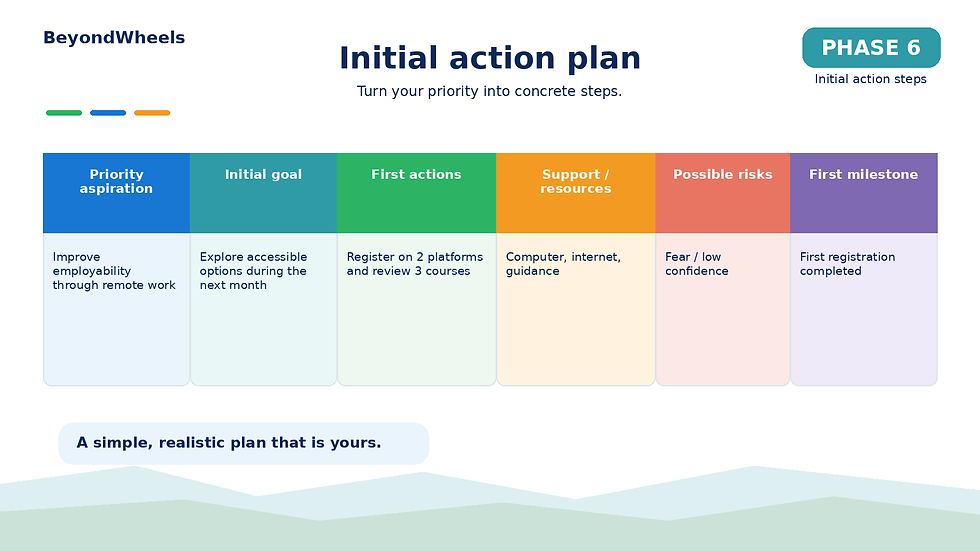
This is the structure explicitly established by the method’s final template.
3. The continuity plan
Phase 6 should not be treated as “the end of the story”. It is the beginning of the work the person will continue after facilitation ends.
For this reason, the process identifies who or what structure can sustain continuity: a peer mentor, a community group, a follow-up professional, an association, a support network or another concrete figure.
The method establishes a clear criterion for closing the process: the person should have three first actions identified for the next thirty days and one identified support for after facilitation ends. If either is missing, the process still requires an additional session.

Two ways of getting stuck
Two opposite risks appear in this final phase.
The first is overplanning: creating a beautiful three-month plan full of actions and starting none of them during the first week.
The second is underplanning: ending with a vague intention and waiting for motivation to appear on its own.
BeyondWheels looks for the middle ground: enough structure to know the next movement, and enough flexibility to modify it when reality changes.
Thirty actions are not necessary.
What is needed are a few possible actions that can actually begin.
What should remain at the end
At the end of Phase 6, the person should have:
an integrated Life Map;
a clearer priority direction;
one or more realistic initial goals;
a simple and flexible roadmap;
recognisable first milestones;
identified risks and support needs;
three first actions for the next thirty days;
and a concrete structure for continuity and support.
The deeper outcome of this phase is not to have the future solved. It is to stop experiencing it as something distant and abstract and begin to experience it as something that can be built through realistic, meaningful and sustainable steps.
Operational summary
Objective: transform the completed journey into realistic and sustainable first actions linked to progressive autonomy.
Main tools: Life Map integration · prioritisation · SMART and progressive goals · roadmap · milestones · risk management · initial action plan · continuity plan.
Central question: What realistic and sustainable first steps can this person begin to take towards their aspirations?
Outcome: Zone 6 of the Life Map —priority, initial goals, first actions, support, risks, milestones and continuity—.


Comments